Monday, 5 June 2023

June 5 Bonifacio


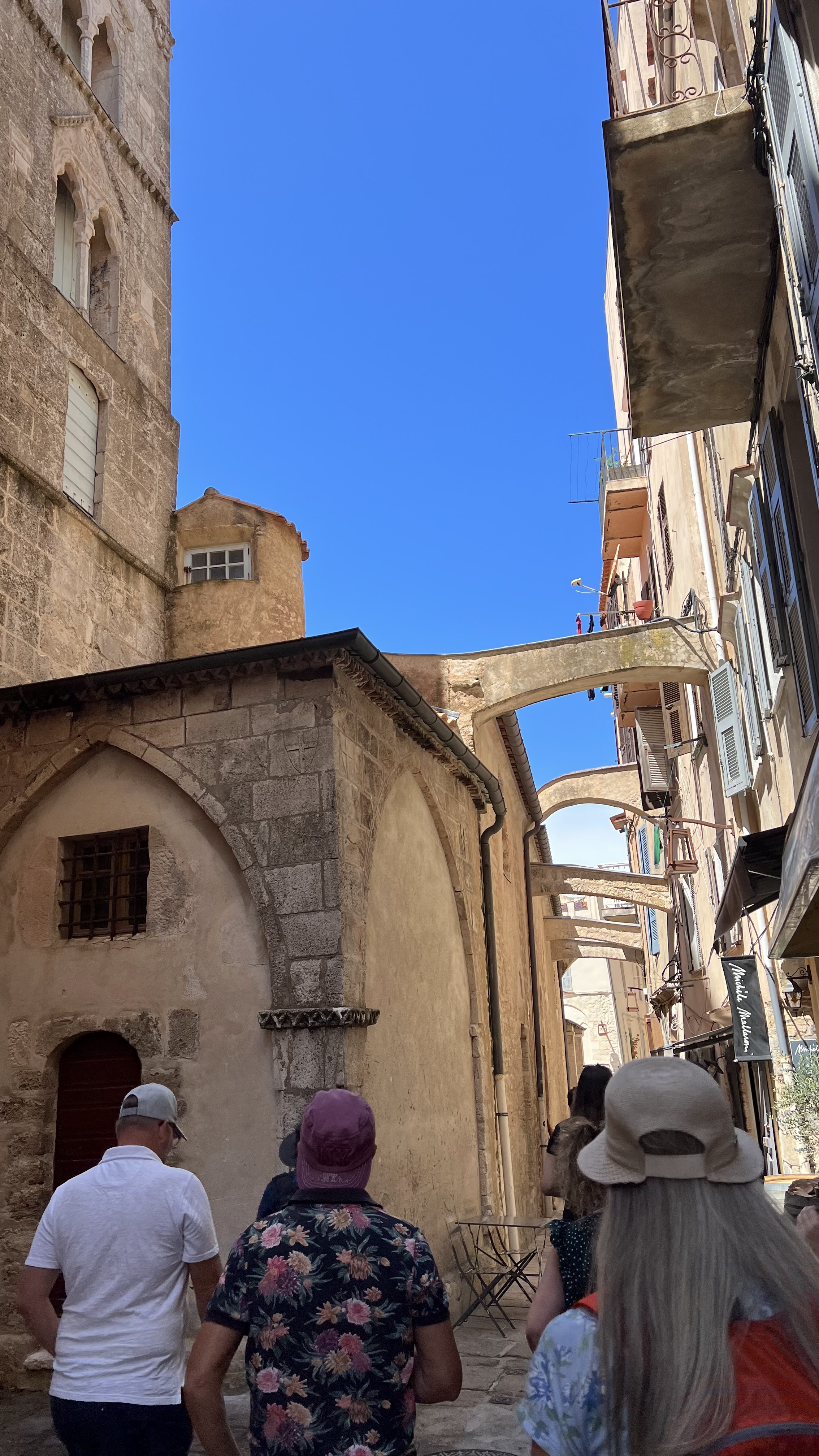
Our first morning in Corscia we chugged up to the clifftop citadel of Bonifacio in a motorised tourist ‘train’ (we’ve seen them many places) where we were met by a delightful Corsican guide whose name unfortunately escapes me. He took us wandering up and down the narrow streets of the old city - fascinating. The citadel was built in C9th with the foundation of the city and has been reconstructed and renovated many times since its construction. 
Evidence of one of the old cistern systems
This street is steeper than it looks yet the electricians
seemed to cling on like limpets.
A fascinating collection of knives on sale here
As we explored we learned a few of the old customs one which I found rather interesting. In Corsica, elsewhere perhaps, young men of a certain age are presented with a knife with which to defend themselves.  The knives are made in this shop, Les Terrasses D'Aragon, as is other cutlery. They were beautiful works of art but looked deadly. 
Those structures leaping between building are small aqueducts
Pretty church

We're looked sraight down the outer walls of the city which some crazy people climbed
And these are the inner walls
Impressive battlements
It had been hot work wandering over this amazing citadel so we were soon looking for a spot to collapse with a cold drink - and lunch.
Bruschetta with prosciutto and fig washed down with icy Aperol Spritz 
That night we escaped the crowd and found a quiet place for dinner. It's wonderful to be alone after being with a busload of people, lovely as they might be. We topped off the night with a couple of favorite liqueurs - Limoncello and Mirta (made from the berries of the myrtle bush)
Limoncello and Mirto by candlelight
Peace descended leaving inky pools dotted with tiny lights and clanking yacht masts. Divine

Sunday, 4 June 2023

June 4 Corscia


Corsica
Corsica, one of the regions of France, is a mere 50 minutes by ferry from Italian Sardinia but so very different. It is the fourth largest island in the Mediterranean. Sicily is the largest followed by Sandinia and then Cyprus. 


June 4 Castelsardo and Bonifacio - from one country to the next


Apropos of nothing at all - this rock formation intrigued everyone
As we have traveled through Sardinia there has been an interesting mix of cultures - Sardinian, Italian and here in Algheto, Catalonian. This small region on the west coast was ruled by the Catalonians for a long time. But it was time for us to move on. This morning we left Alghero and wound our way north to the rather picturesque Castelsardo in northern Sardinia - and yes it has an ancient castle. It is purported to be famous for its basket weaving although on our wander through the narrow streets of this medieval citadel we didn’t see any. We did however see lots of shops selling coral. The Mediterranean no longer has the great coral reefs that thrived 60 million years ago but it is home to more than 200 species of coral some of which are endemic to the region.

Approaching Castelsardo looking quite stunning on its peninsula
Thankfully a bus took us to this point; the rest was was by foot
There were a lot of ups and downs
Prickly pear everywhere. The flowers are very pretty
Occasionally there has to be a flower!
These steps led to a museum but we had climbed enough
We climbed and climbed weaving through this old fortified city - then it started to rain.  Fortunately we found a delightful spot sheltered by umbrellas to sit out a torrential downpour which blew in while we were there - and have a spot of lunch.
A sandwich and coffee with splendid views
Then came the soaking rain
That afternoon we had a mad dash to catch the ferry which would take us across the water to Corsica (France). We only just made it but they wouldn’t let the bus on board so our poor driver Paolo had to wait for the next ferry due a few hours later.
Corsica and Bonifacio in the distance
We were watched by an imposing citadel as we entered the Bonifacio harbour
As we approached Bonifacio the citadel and fortifications loomed high, perched overlooking the sea, guarding the entrance to a cozy narrow harbour. The harbour moorings were choked with huge yachts and cruisers - a giant marina.
Rather stunning view from our hotel window
Our hotel was right on the harbour. It was a little cramped but cute plus we had a marvellous view over the harbour. That night we dined royally.
Entree was mussels gratin and eggplant followed by an osso buco of fish, most unusual.
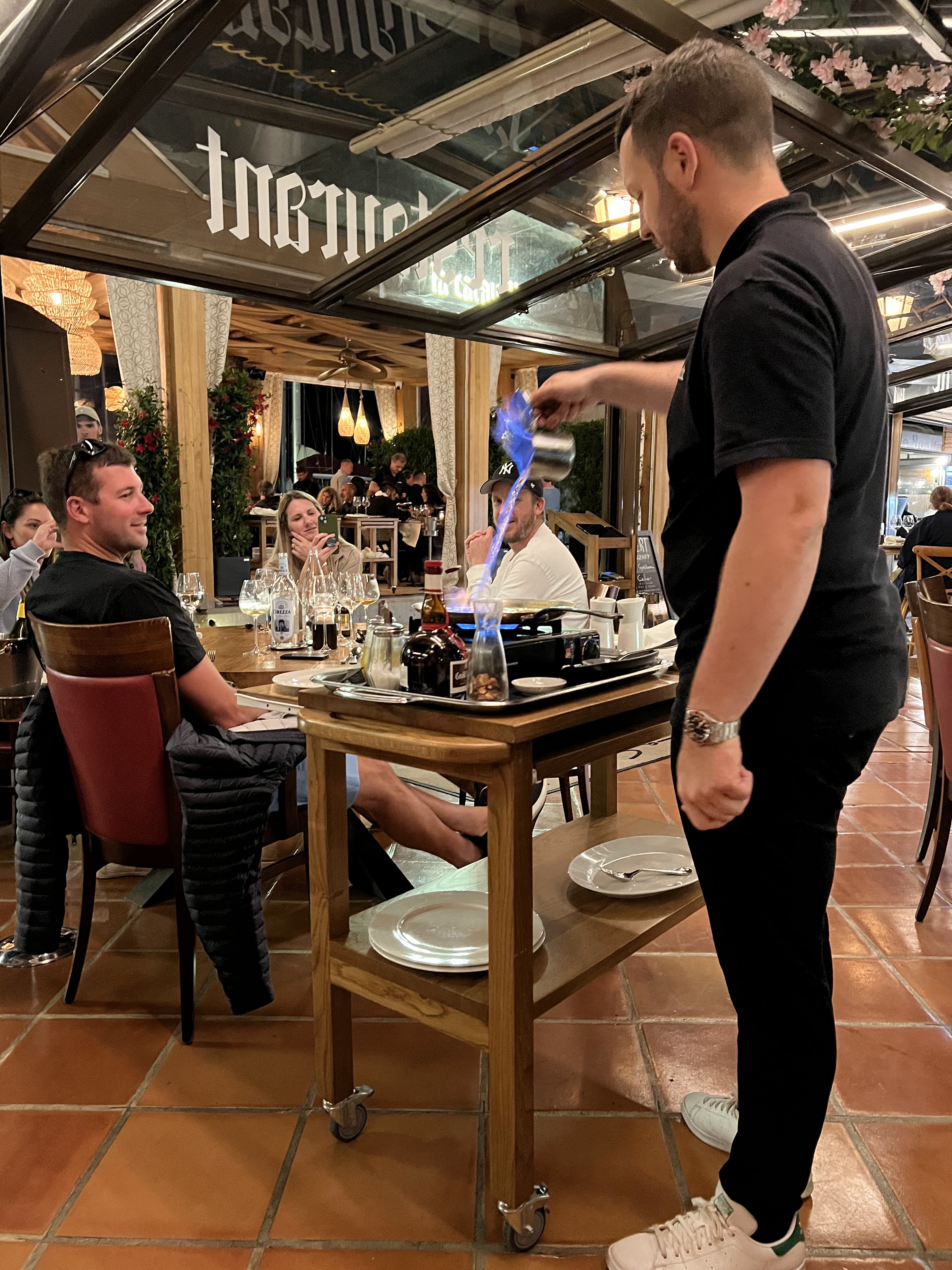
Neighbouring diners had crepes. I was entranced watching the fire leapt up to the jug of brandy

Saturday, 3 June 2023

June 2-3 Across the mountains to the west coast and Alghero

It was hard leaving Su Gologone, such a peaceful beautiful place but leave we did to travel across the mountains and farmland, past the ruins of ancient Nuraghe and towers to reach Alghero on the west coast. It was a lovely drive. 

On the way we stopped at the medieval town of Bosa on the River Temo for lunch and to enjoy a short wander before taking the scenic road along the coast to Alghero. 
Bosa on the River Temo
This was fascinating - a pair of grape vines climbing up the building
Simple lunch - sandwich, beer and fries.
Our bus was parked across the river but what a quaint riverfront
Top L I am told an Iranian Knapweed. The rest lacy wild Angelica of some variety
People braved the busy coastal road to get a look at the coast
Alghero was once part of the Catalan Empire and they still hold to their Catalonian traditions and many to their language. As we have travelled through Sardinia there has been an interesting mix of cultures - Sardinian, Italian and now here in Alghero, Catalonian. 
Moody panorama across the port of Alghero from the Sky Bar
Some of the gates into the Old City
Fortified Old City
The Sky Bar at our hotel gave us a wonderful panorama of this ancient city and its port. That night we got lost in the walls of Old Town trying to find a little hole-in-the-wall restaurant where we were treated to a traditional Alghero-style Sardinian seafood dinner.  
A delightful arrany of small boats - mostly tourist boats
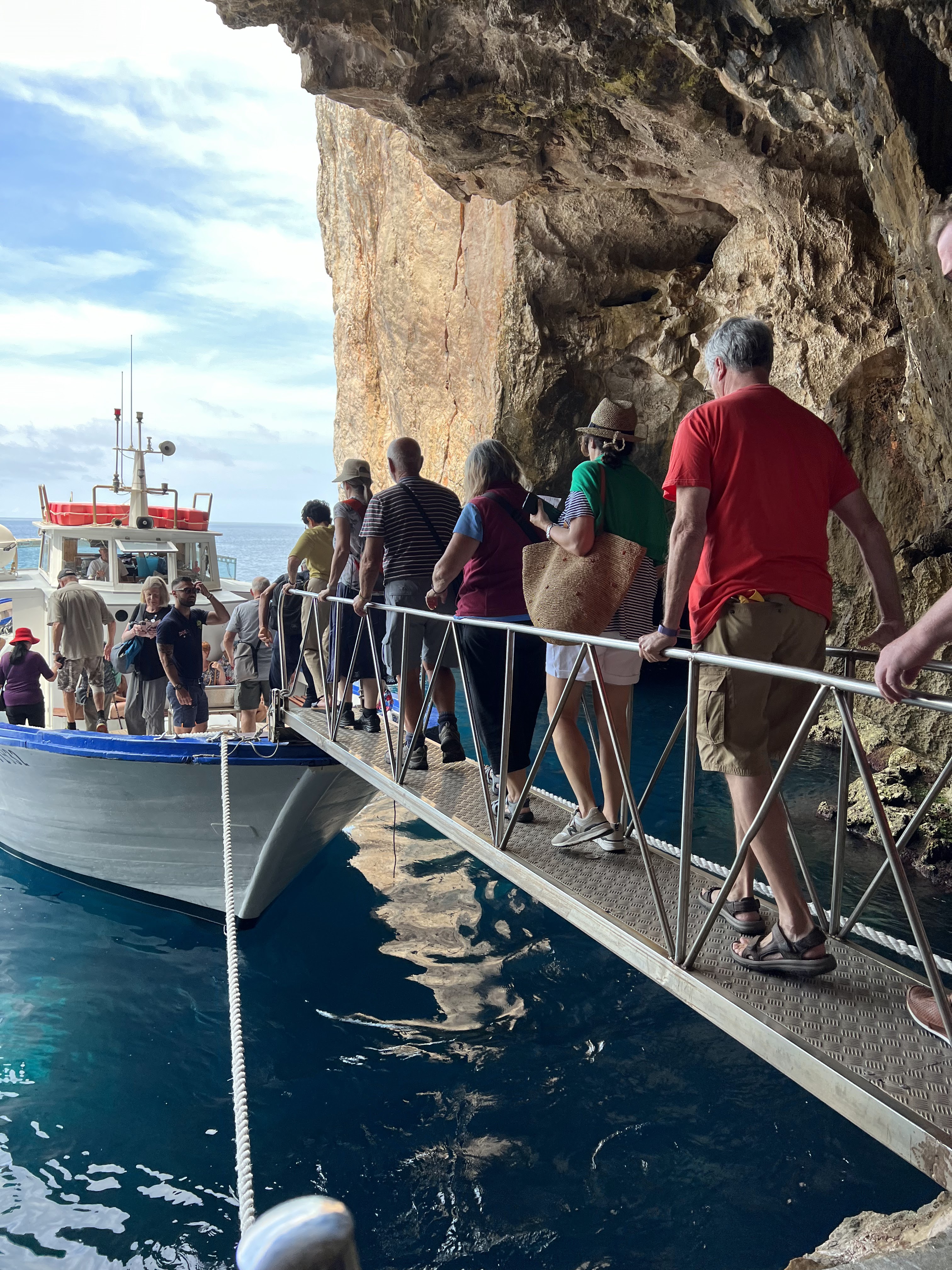
Early next morning saw us on our way to the wharf to board a boat which would take us to Neptune’s Caves under the towering Capo Caccia cliffs. The cliffs were stunning. 

Once disembarked we joined a mass of people who were all crowding into the dark walls of Neptune's 'cavern'. I’m not fearful of darkness and caves but crowds on slippery steps, cheek by jowl is not my idea of enjoying the beauty of nature – I stayed in the entrance cave along with a few others.  
Every picture is worth a thousand words! 
Then we walked the plank back onto the boat

Thursday, 1 June 2023

June 1 Orgosolo - city of murals and bandits


Breakfast was a sumptuous spread daily

Breakfast with a glorious view - Lindsay too!
Our last day in this lovely hotel started with a brief walk to look at the natural springs nearby, Sorgente Su Gologone. a karst spring in the Supramonte Range. It is a veritable flood at times pouring water into the Cedrino River at an average flow of 500L per sec but can reach 8000L per sec when there has been a lot of rain. Astonishing! 

A few of us chose to stay ‘up top, and visit the wee chapel.
But today we were aiming for Orgosolo in this mountainous region. Orgosolo is known also as the ‘City of Murderers’. This quaint mountaintop village was the site of strong protests mainly about a military presence that was being established near the town. It was a quiet but persistent resistance with all residents, children included, involved. The spirit of that protest materialised into huge murals throughout the village expressing concern, anger and disapproval. The painted scenes, people and events are quite revolutionary artworks with portraits of saints and sinners, dictators and world events, oppression, horror and humour.
Some of the murals honoured people who contributed to the life of the village. One woman was revered because she made the bricks for the stoves, another raised silkworms then gathered and spun the silk to make head scarves for the women of the village. She is still doing it today. 
Some of the murals 
More murals which included written accounts 
City of murderers? Until only a few decades ago this was the home and refuge for the region’s notorious kidnappers and bandits (mostly shepherds) who lashed out at restrictions and the political regime which ignored their needs. In the powerless position they found themselves in they reacted in the only way they knew how - stealing and demanding ransom. In 1975 Francesco del Casino engaged his students in painting murals. Among the very first murals to appear was one painted to commemorate the Pratobello revolution of 1969 when residents came together to stop the creation of a military base on common land used by local shepherds. Now the village is peaceful but that fighting spirit lurks beneath the surface I suspect. In the simplest of terms, the village is a social-political history museum, and is one which still lives according to its own rules, customs, and traditions.
Street views of Orgosolo
The village square where we lunched
After a guided tour of the village we stopped for a simple lunch - Sardinian sandwich with beer and wine.
Back at the hotel at the end of the day, we were treated to tastings of local wine. We were supposed to also learn how to bake the local bread, pane carasau , a flat bread with a crisp, flaky texture which is sometimes seasoned or served with oil. The bakers' oven however was outside and it was raining so we just got to eat it - deliciously light. This delicious brad was served as an apéritif dînatoire to another very large dinner.
Wine, bread and artwork

Please visit my other blogs too

At the beginning of most years I start a new travel blog which you can access via the links in the right navigation bar. I also have a recip...