Friday, 4 August 2023

August 5 Limnos Island


Early this morning, the first of this voyage, I stood on the deck as we sailed through the Dardanelles, also know as the Canakkale Bogazi or Strait of Gallipoli, looking over at the Gallipoli Peninsula. Sailing through here was a bit special for me for a number of reasons not the least of which was that we had visited the Peninsula only days earlier and I still had the sounds of the guns and screams in my mind. 

L: En route to Limnos Island. R: (yellow) February 1915, the failed attempt by the British and French fleets to force a passage through the Dardanelles. The Turks had blanketed the strait with mines. (Green) The beginning of the amphibious landing on the Peninsula in April 1915.
Entering the harbour at Limnos
Our first port of call on this voyage of discovery was the island of Limnos which sadly was the departure point for the tragic and ultimately futile invasion of Gallipoli. 
Travelling on board with us was Sebastien Bertrand, Professor of history and geopolitics. He gave his first lecture this morning on Greeks in antiquity. It was very interesting. The day was to be one steeped in history because, after an early lunch, we were ferried ashore to visit the archaeological site of Poliochni which is considered one of the largest urban centres of the Early Bronze Age. 
Poliochni 
It is thought this is the site one of the first assemblies/councils 
It was here almost 100 years ago, that archaeologists discovered seven different layers of civilisations, one on top of the other which is not unusual in itself particularly as the site was locatied high on a cliff looking out to sea – a very strategic position. The Neolithic town predates Egyptian dynasties, the Minoan Kingdoms of Crete and even Troy, but was destroyed by an earthquake in 2100 BC and never rebuilt. It was quite interesting but most of what we were seeing had been ‘reconstructed’ which spoilt it a little for me.  It was pretty hot and exposed so we were thankful to reboard the bus and be whisked off to a local winery for a tour and tasting.  
The rolling hills of Limnos
The wine tasting was accompanied by local cheese - sheep and goat
Lovely countryside but it was time to return to the harbour and the ship
Behind the town the old fortifications still stand watch
Fortifications cap a prominent position 
Cocktail of the day
Every day there was a different cocktail but I have posted this one for two reasons - it is made with gin and the name is hilarious, Corpse Reviver No 2.  I don't know what happened to the first Reviver! Ingredients: Gin, Dry Vermouth, lemon juice, Triple Sec, Absinthe. It looks harmless but it is a real powerhouse.

Thursday, 3 August 2023

August 4 Departing Istanbul bound for Venice

We’re packed and waiting to go! From Sublime Istanbul to Venice the Serenissima - sounds exotic and I know it will be - through the Dardanelles and Corinth Canal and up the Dalmatian and Croatian coast to Venice - the Serenissima - where we will stay for a few days in the Dorsoduro area.

Our ship at the new international docking pier (blue arrow)
I heard our ship arrive about 6am this morning. We could see her from the rooftop of our hotel hiding behind the trees
Our route
Le Lyrial a neat little ship (compared to most). Built in Italy about 7 years ago.
The newmassiveunderground terminal. It needs to be given the cruise ship traffic in and out of Athens
Boarding our ship
Inspiring Istanbul receding into the background.

Wednesday, 2 August 2023

August 3 One last day before leaving Istanbul - for now!

Today was a quiet one preparing for our departure tomorrow aboard Le Lyrial heading for Venice. Of course we went out for a wander and meals and while out I searched for an ancient marker erected back in the days of the Byzantine Empire: the Milion Stone, or Milion Taşı as it is called in Turkish. I almost missed it tucked into a corner at the end of our street. It was built by Emperor Constantine in the C4th when Byzantium (renamed Constantinople) was appointed as the new Rome. Like its counterpart in Rome it measures the distance from Byzantium to all the cities in the Byzantine Empire. - the new Rome  I found it where it always was but now it is being included in an archeologival site being excavated. I have included the photos taken in 2018 and 2023.
Left: The Milion Stone 2023 under restoration. Right: 2018 

One of the minarets on Sophia Hagia with a muezzin calling the adhan
That evening we met up with Deanne and Rob for drinks. Over drinks in the rooftop bar of our hotel we could see a muezzin calling the adhan. At Sophia Hagia it is usually a recording played from this minaret but they seem to have been having some 'issues' over the last couple of days. This evening we could see the muezzin calling the adham through a microphone.  Later we all went exploring for a place to dine. After a dlicious meal, when Lindsay wnet to pay for our meal he was told that the Turkish man who had sat nect to us with friends, had already paid for ours. Such generosity! We had only exchanged pleasantries. That gesture of unexpected generosity warmed our hearts.  We love the Turish people - they are fierce but friendly and love Aussies. The next day Deanne and Rob were flying off to Uzbekistan while we were setting out to navigate to Venice, two more different destinations you would not find! 

Tuesday, 1 August 2023

August 2 To Gallipoli

 Neither of us had contemplated visiting Gallipoli but something pulled me in that direction so we signed up for a tour and were both extremely glad we did.  We had a very early start because the drive would take a few hours with a breakfast stop on the way – a delicious gozleme.  On the way west we passed swathes of bright sunflowers their faces turned to the sun and farmers harvesting. It was quite an interesting drive through the countryside. 

Our breakfasy being prepared
The 1915 Çanakkale Bridge 
Along the route we drove past the 1915 Çanakkale Bridge, a road suspension bridge spanning the Dardanelles. The year ‘1915’ in the official name honours an important Ottoman naval victory against the navies of the United Kingdom and France during World War I. It was after that trouncing that the British ordered the ANZACs to land on the west side of the peninsula to their peril.
Bulent, our Turkish guide, was quite engaging and very knowledgeable. He has been taking groups around this tragic site of  immense horror for almost 30 years. He calls the ‘lone’ pine at Lone Pine his baby as he has watched it grow from a very small tree from one of the seeds collected from the original tree and brought back to Australia after the doomed Gallipoli campaign. The day was packed with so many pieces of history, things I never knew about, but Bulent fitted them together like a macabre jigsaw puzzle. At times, in fact much of the time, the front lines of the Turkish and Allied forces were only metres away. At one place where they were dug in during a stalemate, Johnston’s Jolly, the soldiers from both sides exchanged food, tobacco etc thrown across no-man’s land. There was a bond born of mutual helplessness.
Ari Burnu Memorial written by Ataturk
We saw many memorials which marked specific sites of conflict but at one stood a very moving memorial inscribed with a quote attributed to Mustafa Kemal Atatürk, the first President of the Republic of Turkey. It reads:

Those heroes who shed their blood and lost their lives! You are now lying in the soil of a friendly country. Therefore rest in peace. There is no difference between the Johnnies and Mehmets to us where they lie side by side here in this country of ours. You, the mothers, who sent their sons from far away countries wipe away your tears; your sons are now lying in our bosom and are in peace. After having lost their lives on this land they have become our sons as well.
Atatürk, 1934
Reading the headstones at the ANZAC Cove cemetery made the history so horribly real
Beach cemetery at ANZAC Cove. Those who died were little more than children. Such a travesty
The Sphinx
Bulent took us to many landmark place including a place where we could see a projection on the escarpment called the Sphinx. It is named after the Egyptian monument located near Mena Camp where the First Australian Infantry Force arrived and trained before they were deployed to fight in the Gallipoli campaign. The Sphinx was named by the ANZACs on landing day. They clawed their way up steep cliffs beside the Sphinx. 
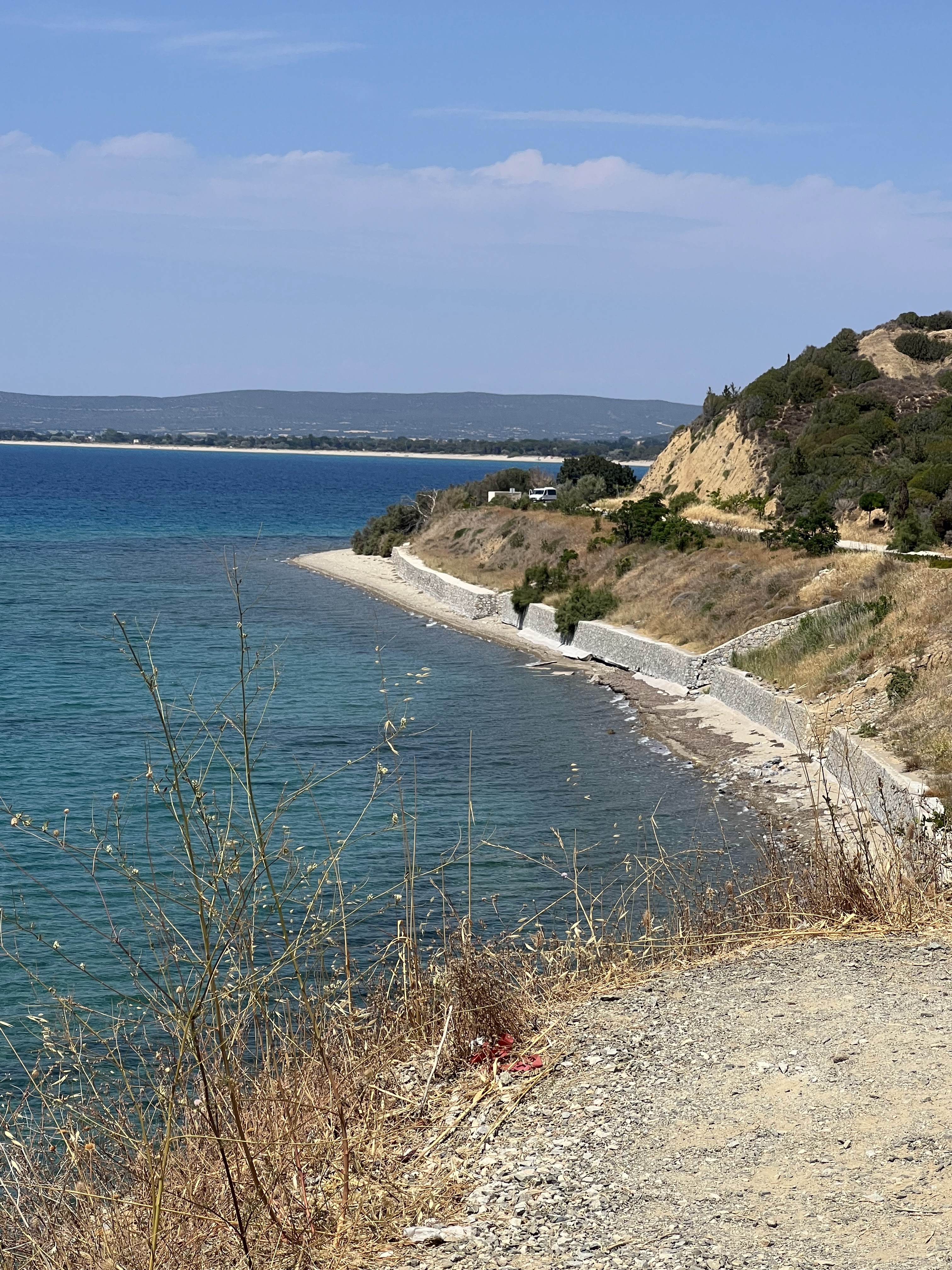
ANZAC Cove
One of the most moving memorials that speaks of the camaraderie between Turks and ANZACs - a Turk carrying a wounded ANZAC. It almost makes you weep

Lone Pine Cemetery
A sobering centotaph at Lone Pine
A diorama. Mines were placed under the enemy posts earning the Aussies their name 'Diggers'.
The entrance to one of the tunnels that pit this entire area

The Nek was a key for gaining the high ground but wave after wave of Aussie soldiers were mown down 
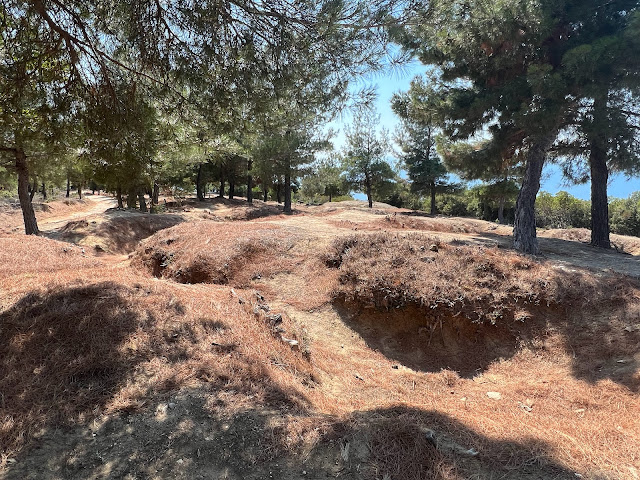
What is left of the trenches is preserved
The areas where the trenches were are protected. It was extensive and it was chilling to imagine the young men surviving in these places throughout a blistering summer and chill winter. In many places the enemy soldiers were only a few metres away. 
The Turkish memorial and one of the cemeteries
So much work has gone into preserving and honouring what took place in that horrendous and disgraceful theatre of war. The rrecords of the ANZACs are fairly good and those who died are acknowledged but they are still uncovering records and information about the Turkish soldiers who lost their lives here.  I almost felt a sense of shame that we fought those Turks. Walking among the Turkish people visiting on that same day with us brought home very clearly the total futility of that campaign, in fact the whole war. They were mourning their dead too. There seems to be a deep mutual respect and  bond between the Turkish people and the Aussies and the Kiwis. 
The memorial to NZ soldiers who gained this high point at the Battle of Chunuk Bair

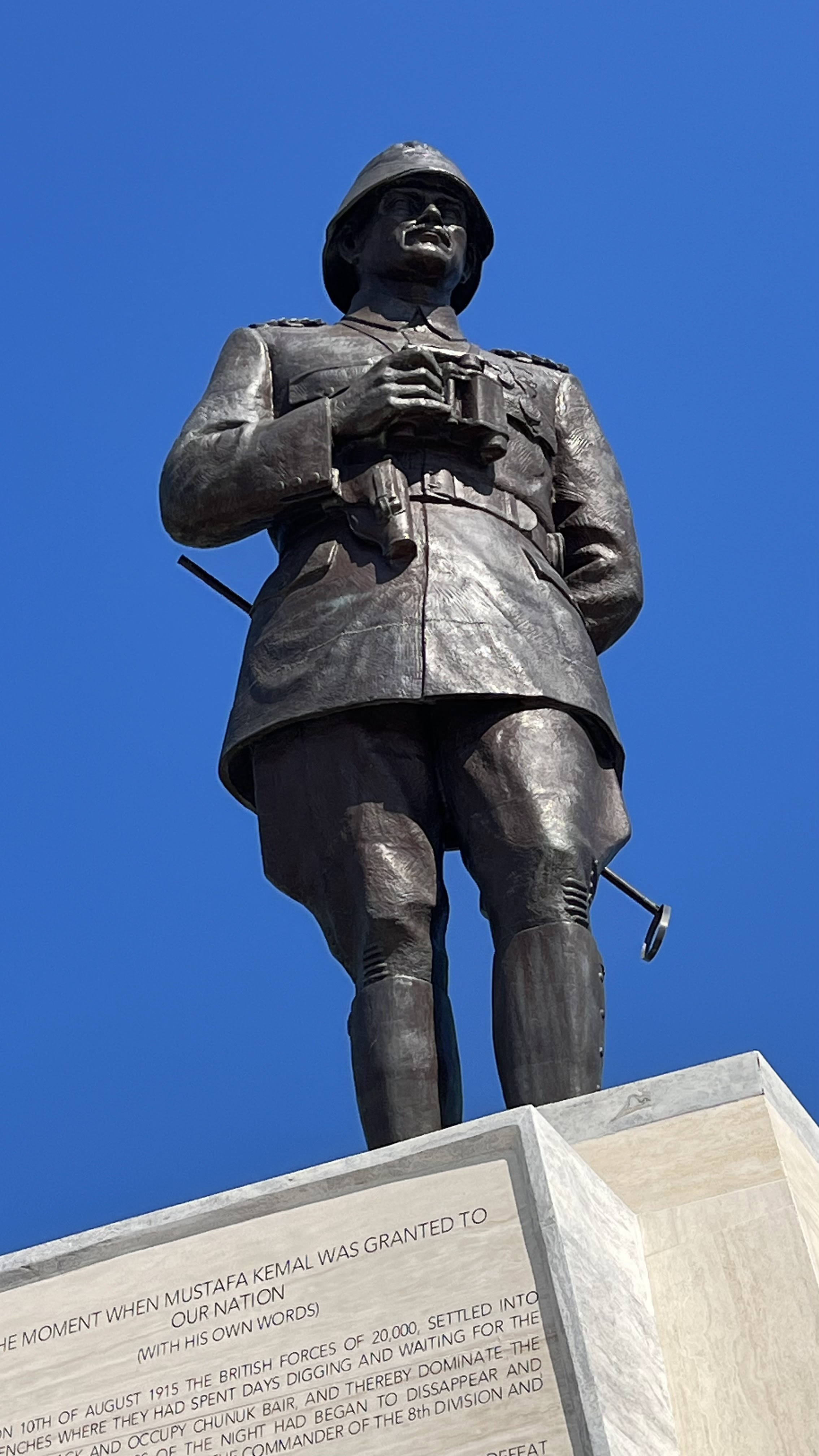
Mustafa Kemal Atatürk
We were all in rather a sober mood and a litttle unsettled when we climbed back into the bus. And the trip back to Istanbul was a bit unnerving too because the driver was speeding – and didn’t always have his hands on the wheel (or his mind on the road)! But the scenery was lovely with the setting sun painting the sky in pink-mauve watercolour patterns as we drove close to the shores of the Marmara Sea. Then we reached the fringes of Istanbul – it was like driving into a maw edged with discoloured jagged teeth but was soon replaced by flashy city lights and dense traffic - quite a contrast to today's extraordinary and very moving excursion. It had been an emotionally draining day but we were very pleased we had taken that journey into the past.

August 1 The Black Sea

“The men who go down to the sea in their ships,
Who sail on the water and pursue their trade,
The sound of the sea echoes back from their lips;
Their eyes see the wonders of what God has made.…...” James A Tweedie 

Well we went also down to the sea today - not in a ship but in a bus. The Black Sea! What does that conjure up in your mind, barring more recent ‘times’? I have had only vague notions of the Black Sea - secondary school history - soldiers, war, Sebastopol, Crimea, Florence Nightingale, Russia, and romantic notions of exotic remoteness. and its shape so like Australia! I have wanted to visit this vast inland sea for a long time and today I sat on its shores on the sand with my feet almost in the water watching happy families playing. It was an absolute delight. 

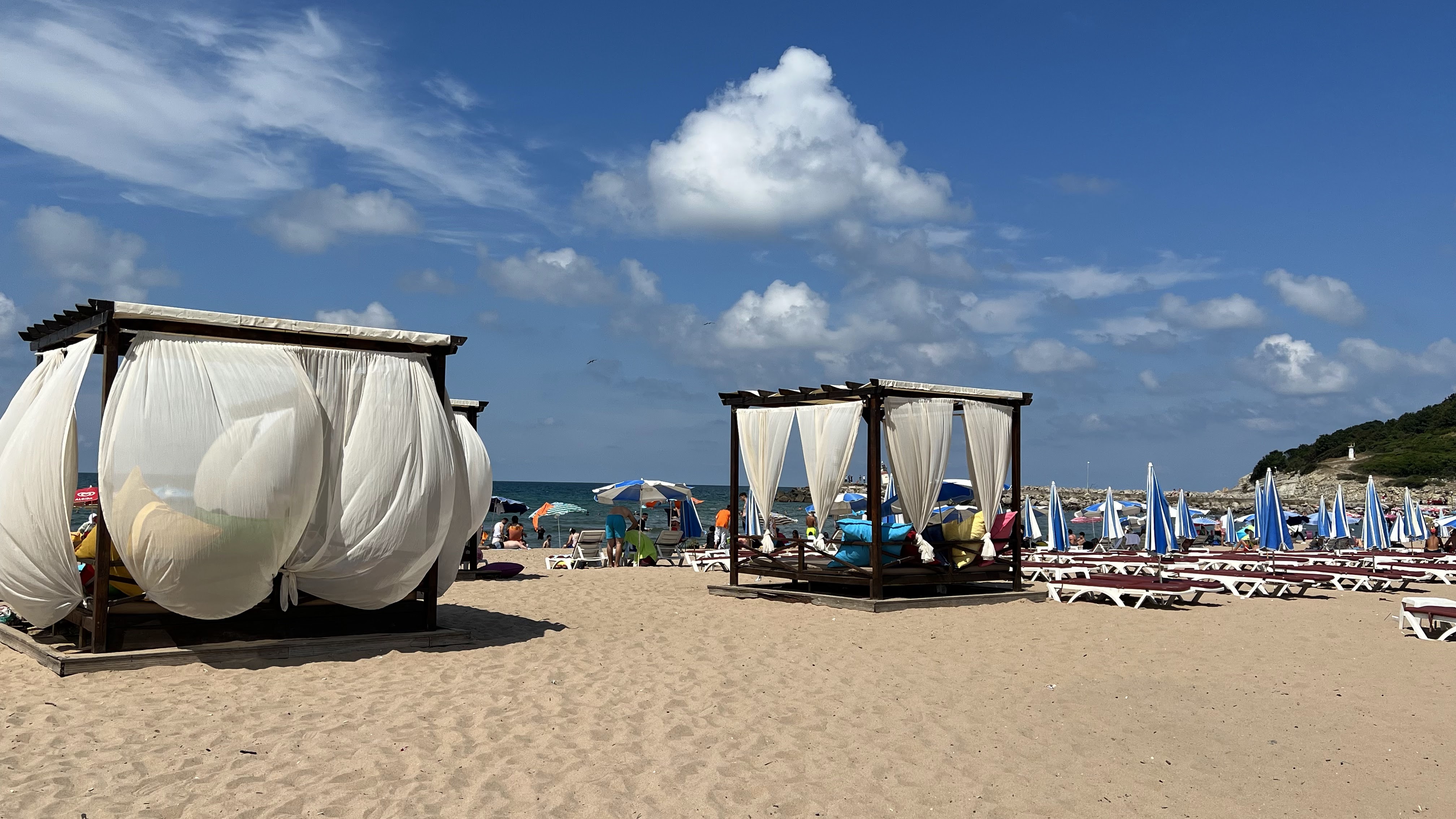
Wonderful cool beach ‘boxes'
We weren't sure if the roped area was a safe plae for kids or a women and children only area
Lindsay wandered the water's edge
Families at the beach like anywhere else in the world.
This teenager walked around for ages in her 'modesty suit' phone in hand 

Hookah pipes were available at the beach cafe
Here at the beach and many other places you could order a hookah pipe.  The flavours are various including lots of fruit flavours. I tried one last time we were in Istanbul - it was too long since I had smoked.
The whole day was an interesting experience. We were on a tour catering mainly to people from Arab states, the predominant tourist population here in Turkey at the moment.  Barring a couple of people, we were the only English-speakers on the bus. I got into conversation with a delightful man holidaying from Jordan who is an intensive care nurse. I also got chatting with a lovely young Egyptian man who was heading to UK to study robotics engineering and AI - we were both tracking the bus on our phones and puzzling about the route the bus was taking (two nerds separated by many decades ). I reckon I probably look like their grandmother and am safe to talk with.  We drove through forested country and visited rivers and a tranquil hidden lake. It was a bit touristy for our taste but a marvellous opportunity to see parts of Turkey we would not otherwise have seen. Plus the Black Sea!!  It was a long but interesting day.  Tomorrow we head for Gallipoli. This is an interesting land and we are slowly learning how to be here and are developing an appreciation of its people and culture.
Huge comms tower ahead recently completed with a restaurant on top
A new mosque being built in a city with over 3000 mosques!
We stopped at Sila on the coast - and other places

A cut-out cop car! I wonder if it works? 

En route we encountered lots of road building including tunnels

We took a delightful cruise along the Goksu River
People live and holiday along the river banks
On the way home we stopped at hidden artificial lake, Sakligol. The restaurant there is very popular
Then it was back into the hubbub of the city.

Please visit my other blogs too

At the beginning of most years I start a new travel blog which you can access via the links in the right navigation bar. I also have a recip...