Yesterday our last day in Modica, actually our last in Sicily, was one of those interminable transition days – waiting to board a bus then waiting to board a ferry. The ferry was to take us to Malta – hooray!!
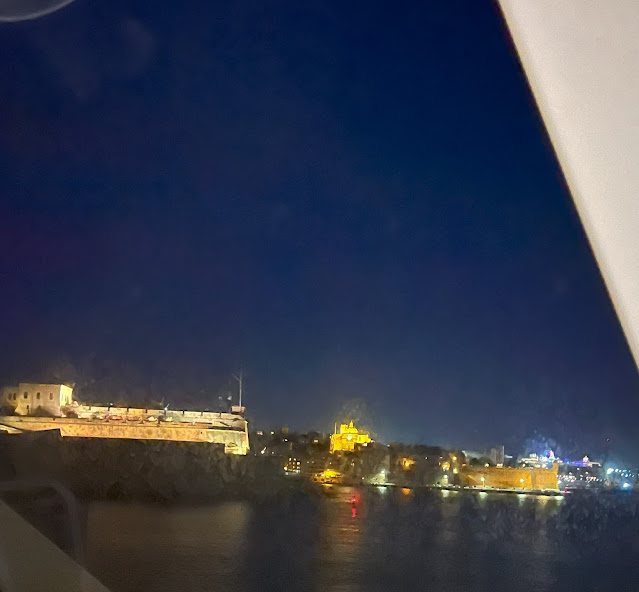 |
| Terrible photo but I was so excited to finally be arriving in Malta |
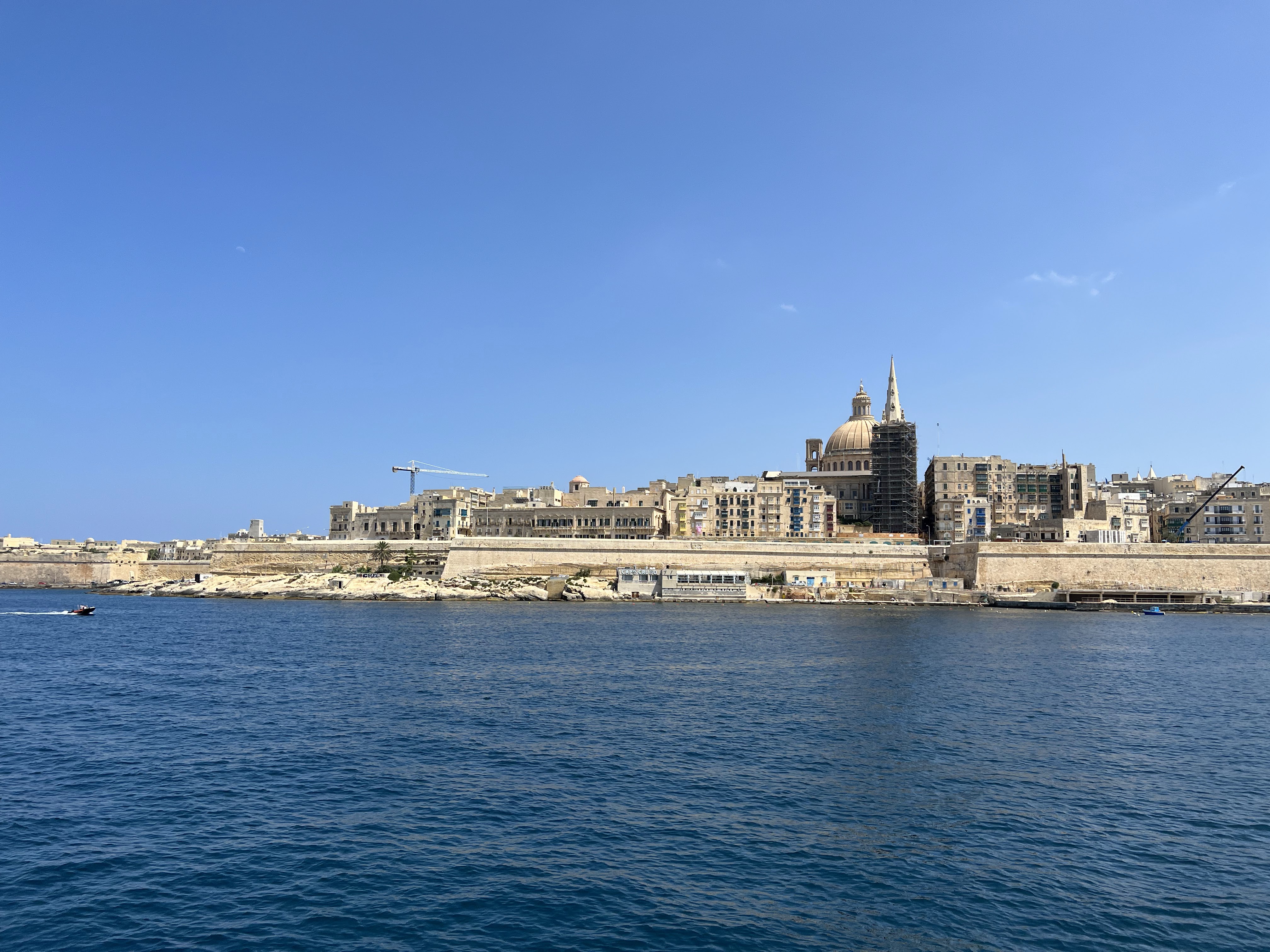
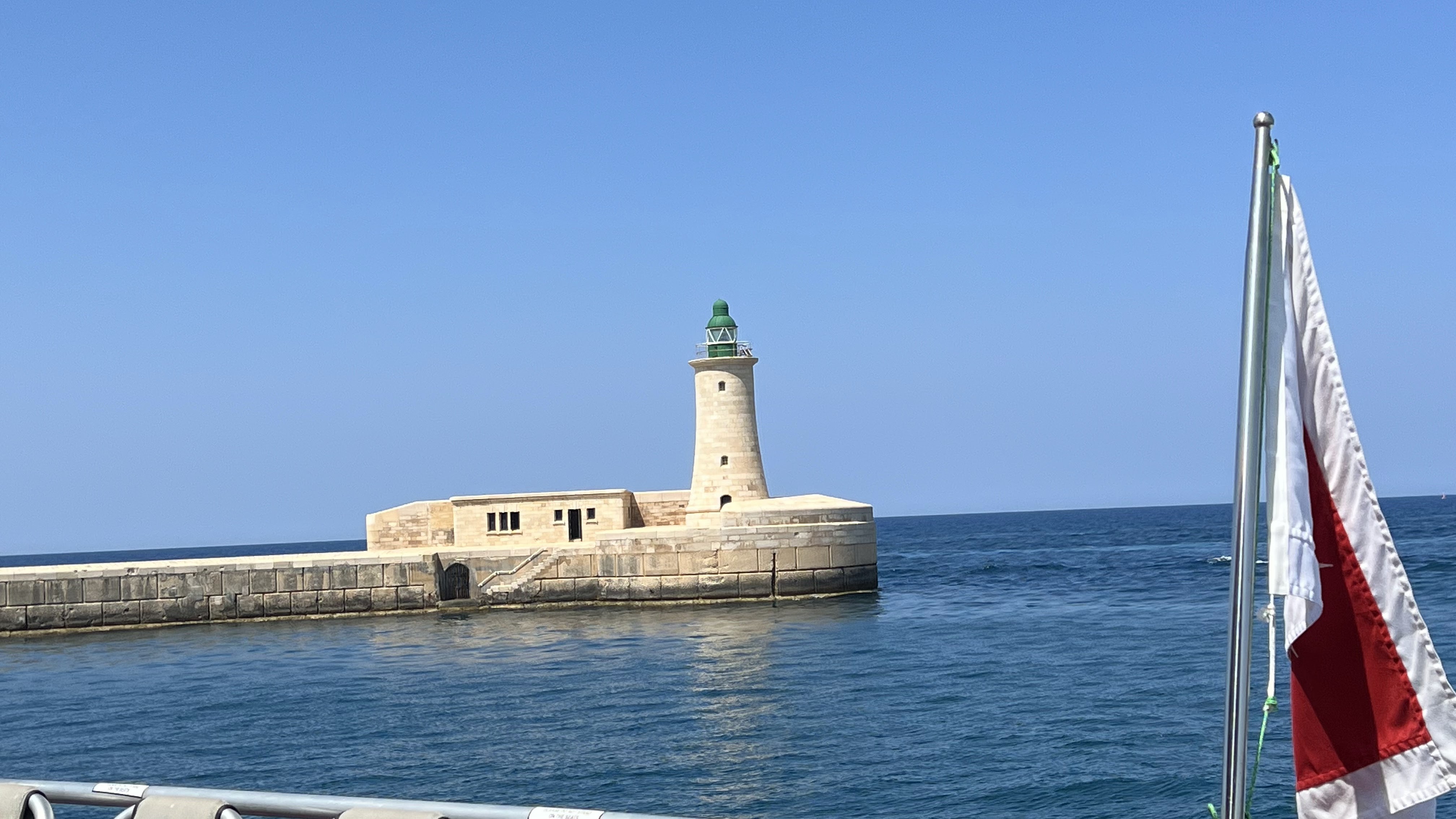
Entering the ancient harbour was magnificent. All the photos you’ve ever seen of Malta – it didn’t disappoint! We were pretty pooped so were very happy to be whisked off to our hotel, a grand affair on the edge of the harbour, and collapse on the bed.
 |
| Breakfast with a view |
 |
| Grand Hotel Excelsior - view out to the pool. It also has its own marina! |
Next morning after a lavish breakfast we were off and running or rather climbing – we had to get from the hotel to the old city, basically the citadel. It was to be a walking day, at least part of it.
 |
| We were to walk past this sculpture many times over the next 4 days |
 |
| Part of the city walls |
 |
| The old Royal Opera house - built and destroyed many times |
A local guide walked us through part of the city. Astonishing! Thousands of years of history. More recently, 500 years ago, the King of Spain gave Malta to the Knights of Saint John of Jerusalem and Valletta became their capital. Here they built one of the mightiest fortress cities in the world. UNESCO listed of course. The ramparts are enormous and really need to be seen to be believed.
We visited the St John’s Co-Cathedral with its sumptuous, opulent, overwhelmingly dazzling interior.
 |
| The floor is made up of the graves of Knights past |
 |
| the tapestries were magnificent but they are being removed for preservation - for how long? |
 |
| The Maltese Cross |
The eight points of the eight-pointed cross have been given a number of symbolic interpretations, such as representing the eight Languages of the Knights Hospitaller -Auvergne, Provence, France, Aragon, Castille and Portugal, Italy, Germany, and the British Isles; or alternatively the 'eight obligations or aspirations' of the knights. [What one is told by the tourist guides has to be taken at face value rather than as absolute fact. That plagues us as we travel wishing always to know and understand the world and its history.]
We then entered the sacristy and that was quite breathtaking even a little spine chilling. No one spoke. Some of Caravaggio's paintings hang there - the beheading of St John the Baptist and St Jerome who translated many biblical texts into Latin from Hebrew, Aramaic, and Greek.
 |
| A modest entrance to such opulent grandeur |
And now, after a pause to try and absorb what we had just seen, we headed for more wonders.
 |
| Intersting bit of history. Malta although independent is still very British |
 |
| Some light relief! |
 |
| Many of the buildings have these enclosed balconies often is bright colours |
 |
| We were to have visited St John's Hospital - the very heart of the Knights of St John - but sadly didn't! |
We seemed to have been climbing for ever yet we climbed a little more before descending to the St Elmo Bastions where we climbed down steep steps into a dungeon-like space for the ‘Malta Experience’. This turned out to be a 3D film depicting 7000 years of Malta’s history. A brilliant experience and a fascinating history (we were to see some of the ancient ruins a couple of days later).
 |
| Inside St Elmo Bastions |
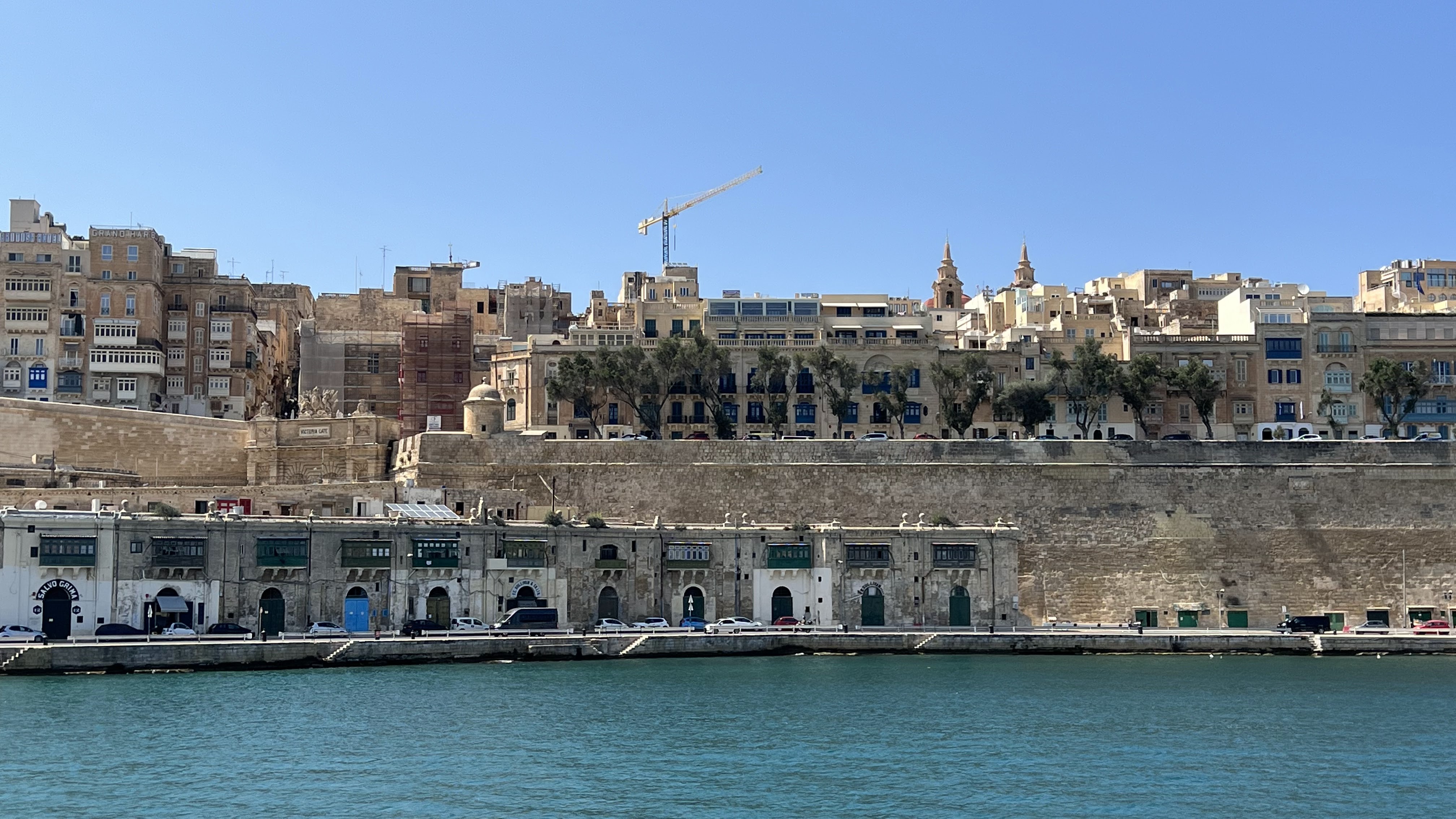
Our bus picked us up and whisked us off to Sliema where, after a light lunch, we boarded a boat for a harbour cruise - the harbour is huge with multiple 'arms' and the sights are wonderful. The battlements seem to start right at the water's edge and are tiered up and back to enclose the cities. The Knights of old had a huge waterfront to defend.
 |
| Sliema a pretty port |
 |
Aperol Spritz were becoming my go-to thirst quencher.
|
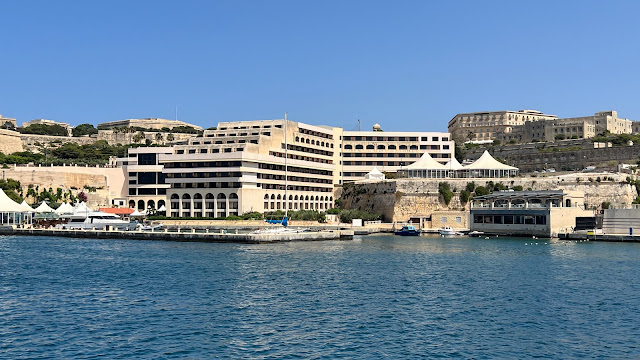 |
| Our hotel right on the water but built into the city wall |
 |
| I thought that this might be a small naval base but Malta does not have a navy, air force or coastguard. Her armed forces are equipped with a maritime and air component. |
 |
| The Upper Barrakka Gardens built on the upper tier of St Peter and St Paul Bastion built 1560s. |
 |
| The cruise liner looked so incongruous against the ancient battlements |
 |
| There are many huge private yachts moored in the marinas dotting the harbours |
 |
| Yes that is a lift - up to the Upper Barrakka Gardens. |
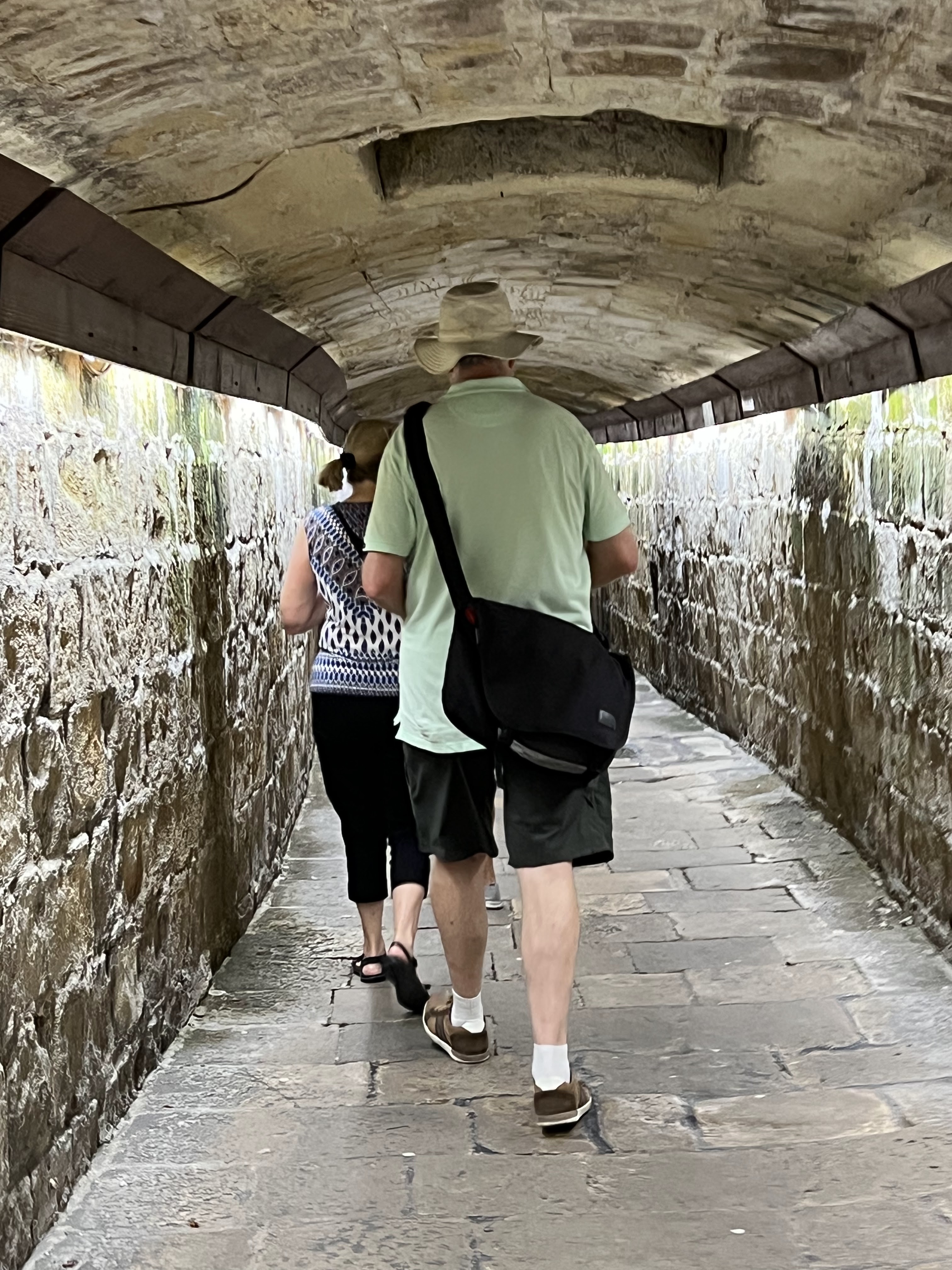
That evening feeling pretty exhausted after a very full day, we climbed back to the old city to a marvellous restaurant built within the city walls – Rampila. We had to climb countless steps only to then dive down narrow steps and out onto a wee terrace right within the walls of the old city. It had been a huge but fascinating day.
 |
| It seemed steep at the time - actually it was steep! |
 |
| Aljotta fish soup followed by traditional rabbit stew |
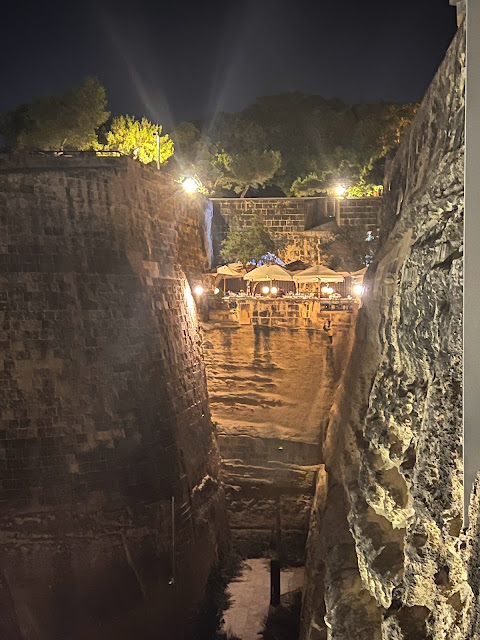 |
| Rampila nestled within the city walls |
 |
| Rampila restaurant in the daylight |