Wednesday, 9 August 2023

August 9 Dubrovnik, Croatia – so much to see, too much to take in!

This cruise has been, and continues to be, a wonderful, continuously unfolding slow revelation, of stunning land- and history-scapes: the Dardanelles, Bronze-age Poliochni, the spectacular Meteora and its monasteries suspended between heaven and earth. Crossing between the Aegean and Ionian Seas via the Corinth Canal had us leaning over the railing for well over an hour marvelling that our ship managed to skinny through the Canal - an amazing engineering achievement. We’re now on our way to Dubrovnik to wander its cobblestone streets. All the while classicist, Dr Sebastien Bertrand has been weaving a fascinating story about the occupation of the region through history - the real ‘Game of Thrones’.

The walled city of Dubrovnik
This afternoon we anchored and were ferried to the historic walled-city of Dubrovnik which sits on a rocky spur. Once landed we wandered for over four hours, through streets wide and extremely narrow - and of course up and down steps!  Fascinating. 
The limestone pavement stones have been worn smooth and slick by 100s of 1000s of feet
Entering a pharmacy-museum which has been operating constantly for 100s of years.
Everywhere is steep steps
Washing day!
We watched as tourists struggled with luggage on these steep steps.
Another museum
Then our guide turned our eyes up to the top of the ‘mountain’ - we were to catch the cable car to the top. It seemed like we had walked halfway up that mountain already but up we went to catch the cable car - phew! What astonishing breathtaking vistas awaited us when we reached the ‘top’ and gazed out over a polished pewter sea and inland when we could see in the near distance northern Montenegro, Serbia, Kosovo, and almost to North Macedonia (and probably Albania just over the horizon). 
The view as we were whisked skyward in the cable car
We are being tracked by our shadow! A patch of Japanese garden in the sky
At the top of the hill we looked out over 3 countries. An experience I haven’t had since Uzbekistan.
AT the top we were served drinks and nibbles but too soon it was time to descend -  it was so much better going down but it was a longish wait.
Such a beautiful little port
Back over the drawbridge to walk between the walls
We arrived back on board ship with just enough time for a cocktail before dinner. The night was glorious and the weather balmy so we lingered by the pool sipping White Port and Cointreau - we were waiting for the night’s entertainment: a group of local men performing a traditional Klapa. (The word klapa translates as ‘a group of friends’ and the singing is a multipart tradition of the southern Croatian regions of Dalmatia.) They accompanied themselves with mandolas, mandolins and guitars. Plaintiff songs and perfect harmony. Their singing was heartbreaking, mesmerising. I made a couple of videos and took many photos – they were sensational. Sadly the video had to be cut a little short but I know you will enjoy it nonetheless.
The black night sky was a perfect backdrop for this wonderful group of local musicians

August 9 Beautiful Kotor, Montenegro


Bay of Kotor circled in blue
The natural beauty seem so intensely packed along this stretch of the Dalmatian coast. Yes I have wondered about the name too! It stems from an Illyrian tribe called the Dalmatae.  According to Prof Bertrand, the Illyrians were a group of Indo-European-speaking people who inhabited this region in ancient times – C8 BC - C5 AD.  Later the now-extinct Dalmatian language emerged only to be replaced later by Venetian – geopolitics abound!

Besautiful miniature islands in the Nay of Kotor
we sailing into the bay leaving just a small wake
Kotor on the distant shore
Montenegro! Such a romantic name. It derives from the Serbian ‘Crna Gora’, meaning ‘Black Mountain’ because of the appearance of Mount Lovćen which was covered in dense evergreen forests.
This morning we spent a few heavenly hours navigating around the deep fjord-like Bay of Kotor which is jaw-droppingly beautiful. Almost everyone was on deck as we slid quietly and slowly towards the medieval city of Kotor. 
‘Camouflaged mooring’ for vessels of the old Yugoslav Navy
As we left Kotor Bay we saw a tunnel entrance along the waterline - not entirely by chance I might say because I was looking for something fitting this description. I had very little idea where it might be, but here it (or one of them) was. An entrance to one of the ‘camouflaged' mooring tunnels for attack vessels of the now defunct Yugoslav Navy. At the entrance to this, and other tunnels along this coastline, metal arms topped with rock-like chunks of polystyrene were designed to swing across the entrance, transforming it into what looked like a rocky bay when viewed from the air.  
All too soon we were out in the Adriatic heading for Dubrovnik.

Tuesday, 8 August 2023

August 8 The Island of Corfu

This morning we docked at the island of Corfu which lies off the west coast of Albania and Greece. The old town is perched strategically at the entrance to the Adriatic Sea and dates back to the C8 BC. Small though the island is, it has been fought over for millennia - the Byzantines, Venetians, Ottomans, more recently French, British and Greeks.  Not surprising then that the Old Town has been well fortified and over the course of time, those forts have been repaired and partly rebuilt several times. The forts were designed by Venetian engineers.

Corfu is located very strategically for many countries north
Approaching Corfu harbour
We were only there for the morning and passengers could disembark and go ashore. As there were quite a few other cruise ships docked there, we chose not to fight through thousands of sightseers so stayed on board. That afternoon we continued north through quite choppy seas towards Montenegro. Our journey was accompanied by a though-provoking lecture from Prof Bertrand on the geopolitics of the Mediterranean. 
Large tourist ship pulled in beside us in the harbour
This vessel disgorged thousands of eager tourists into the cobbled streets of old Corfu 

Sunday, 6 August 2023

August 7 Navigating the Corinth Canal


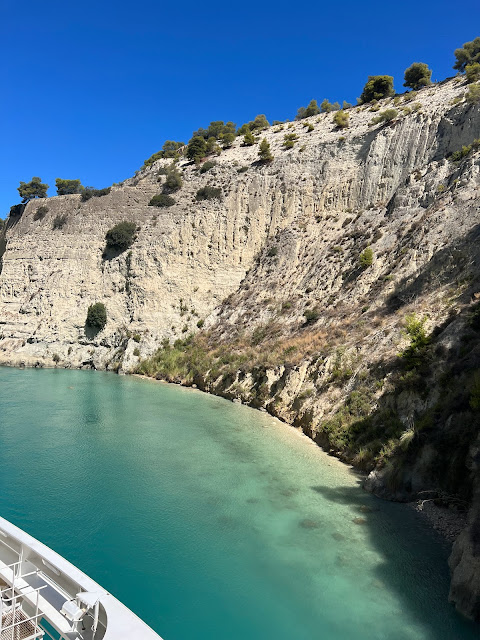
This morning we were all up on deck to watch our approach to the Corinth Canal. Fascinating watching as a tiny tugboat lashed itself to our ship and also to watch as vessels lined up to enter the Canal - the traffic was eastward-bound when we arrived which meant we had to wait. The Canal, an extremely narrow strip of water sandwiched between tall ochre cliffs, cuts through the Isthmus of Corinth, connecting the Gulf of Corinth in the northwest with the Saronic Gulf in the southeast. As a matter of interest, its construction/excavation preceded the building of the Panama Canal by 20 years. 

Waiting to enter the Canal ahead
Cars and people were lined up either side of the Canal waiting to cross presumably via a 'punt'.
Before the Canal was built, depending on where they were coming from ships were forced to make anything up to 700 nautical miles long dangerous journey around the Peloponnese Peninsula. Then around 600 BC, Periander reportedly one of the great rulers of Corinth (but also a tyrant), had the brilliant idea of taking ships out of the water and pulling them overland on wheeled wagons across the Isthmus on a ‘road’ partially paved with stone (undoubtedly slaves did the lion’s share of pulling). The track was called the Diolkos. Evidently parts of it are still visible but we didn’t see any sign of them. We did however see what was supposedly part of the port on the Saronic Gulf side when we took a bus tour from Athens to Corinth two weeks earlier. Centuries later in 67 AD, the Roman Emperor Nero attempted to have a canal dug between the ports using 1000s of slaves, but the project was soon abandoned.  Apparently this labour-intensive overland ship-transporting system was used until about the C9, by which time ships had become too large to haul. In 1882 work began as a joint venture between Greece and Hungary on digging out, mostly by hand, the Corinth Canal. It was opened 11 years later in 1893.  Today along it gives passage to thousands of tourists ships it is too narrow for modern ocean freighters, as it can accommodate ships only up to 17.6m wide. As we sailed through we sometime thought we'd scape the sides - we just fitted I reckon.
It seemed as if we would scrape the sides it is so narrow. Navigation lines are placed along the Canal length (red arrow) 
Only two weeks earlier we had peered down from that bridge at this narrow trough.
Just above our heads people were lined up to bungy-jump into the Corinth 'canyon'.
Amazingly there was some vegetation clinging to the steep slopes on the Canal.
Here I think a cliff collapsed. Our ship was drawn off course by the change in current
Some shoring-up and new construction along the canal. 'Zaxarias '- a little graffiti carved into the walls.
The Canal is quite a phenomenon and of course is a popular tourist attraction – our progress was watched by people hanging over the edge of bridges we passed under. It really is worth experiencing.
.... and two hours later we popped out into the Gulf of Corinth
Two hours later we emerged into the Gulf of Corinth. Before we left the Gulf of Corinth, we passed under the massive Rio–Antirrio Bridge. It is the world's longest multi-span cable-stayed bridge. Its official name is the Charilaos Trikoupis Bridge. It is quite something to behold.
Charilaos Trikoupis Bridge. The world's longest multi-span cable-stayed bridge
It had been a fascinating day and it wasn't over yet. On board we had a Professor of History, Geography and Geopolitics, Sebastien Bertrand. Over a number of days he talked to us about the ancient Aegean and Adriatic Seas, the discoveries, the battles for domination etc, all places that we  would be navigating through on this voyage. If that wasn't enough (and I was already quite happy), as with all our days at sea we were tempted with 'Tea Time' (on a French ship?). Today it was Mille feuilles (one of my favourites).  Later during the cocktail hour we were able to do a tasting of Pata Negra, famous Iberian cured ham. Life's not too bad on board!

Saturday, 5 August 2023

August 6 Volos and Meteora


Approaching Volos
Early this morning we docked in Volos, one of the biggest port cities in Greece. It is located at the foot of Mount Pelion which, according to mythology, was a place of ‘celebration’ for gods and heroes, and the home of the centaurs. In Greek mythology, Chiron was held to be the wisest and most just of the centaurs, a great healer, astrologer, teacher and tutor.  This is the land of myth of Achilles and Jason and the Argonauts who set out in search of the Golden Fleece.  Greek mythology is mighty.  But back on track ……. we were heading for the famous Meteora and its monasteries suspended between sky and earth. That region is a very popular tourist destination and our excursion was going to be about eight hours. So we breakfasted early ready to disembark and board a coach which would take us northwest through the agricultural plains of Thessaly to reach Kalambaka, a small town nestled at the foot of the Meteora rocks. 
Top: Here they grow apples, plums, cotton, tobacco, sheep, wheat and barley (water is pumped from underground for irrigation). Bottom: Pindus mountain range runs like a backbone from north to south.
Along the road we passed many tiny shrines-chapels commemorating a loved one

A miracle this spire-like rock remains standing
Top L: Kalambaka. Bottom R: Halfway up this cliff is a cave dedicated to St George.
Not far from Kalambaka halfway up an almost vertical cliff is a cave where a woman built a sanctuary to St George after she prayed to him to cure her of an illness - she was cured. She or others climb there every year and leave a scarf.
Here and there are giant rocks with bizarre shapes and which range in height from 100 to 150 metres. Atop these giant tors are the ‘monasteries in the sky’.  
Some of monasteries of Meteora
Once a monastic community with 24 monasteries, Meteora now consists of only five active monasteries. They were first built in the C14 by monks searching for a place where they could stay isolated and pray undisturbed by the rest of the world. Until 1920 most of the Meteora monasteries could only be reached by getting into a net and being hauled up by a rope - we saw one of those nets when we reached one of the monasteries. Later the net was replaced by a cage which was also hauled up by rope. Fortunately, steps were cut afterwards to all of the monasteries although some also have elevators I believe and at least one has a cable car.

Climbing to reach the Holy Trinity Monastery perched high above the canyon floor
Top L: The platform where visitors were hauled up to. Bottom R: The capstan wheel that operated the rope on net or later cage 
We climbed almost 200 steps to reach the Holy Trinity Monastery perched almost in the clouds high above the canyon floor. Coming down was a little scary as you were very aware of the precipitous drop to the canyon floor. We visited the place where people were hauled to from, or were let down to the canyon floor. I believe there is an icon at the top of the haul that was kissed in gratitude by those who made it to the top (evidentially, they only replaced the rope when it broke - ouch!). I am just glad we got a ride halfway up and there were steps!. 
12,000L wine barrel - that's a lot of wine and headaches!
Holy Trinity Chapel and grounds
The chapel was surrounded by tranquil well-ordered gardens. Once inside in the cool of the vestibule we were surrounded by glorious iconographs and paintings shimmering with gold and silver.  The dress code for women to enter the chapel was that knees were to be covered by a shirt. My knees were covered by respectable trousers and a top that almost reached my knees but that wasn't good enough. I managed to sneak through in the crowd however to ogle the breathtaking interior of the chapel. Sadly no photographs were allowed. Suffice it to say the chapel although small, was stunning and quite opulent. Next stop was at the Holy Monastery of St Stephen - a nunnery which like the other holy places was perched on towering rocks. We approached this fortress-like complex across a narrow bridge spanning a deep rocky gorge. The wind was quite ferocious so I didn't linger on the bridge to take pix but held tight to my hat and other bits and pieces . The gorge below the bridge was quite scary. Again my attire didn't pass muster but our delightful guide Costas appealed to the Sister on the gate and I was allowed to enter. Thank you Costas. Inside the chapel was glorious but again no photos were allowed. The setting was lovely with quiet gardens and stunning views.
Stunning view from the Holy Monastery of St Stephen
Bottom L: The daily 'events' of the nunnery were signaled by this bell-like structure
After our visit to the monasteries, we returned to Kalambaka for a typical (touristy) Greek lunch. Then it was time to pile into the buses for the 2h30m drive back to the port of Volos and out ship. It had been a  wonder-filled day.
Fascinating old quarry with cypress growing along the excavated levels.
..... and we sailed off into the sunset!

Please visit my other blogs too

At the beginning of most years I start a new travel blog which you can access via the links in the right navigation bar. I also have a recip...